Open reference
Listening words: how to describe a voice

Shared words for describing what we hear in a voice clip. Institute of Thinking made this list for its own research and shares it under the CC BY 4.0 licence. Each word has one plain meaning and, where it helps, an example sentence. A word with a note number is defined from that source; a word without one is our own working wording, written with the help of Claude, an AI assistant.
How to report what you hear
Say where, what, how strong: "At second twelve, the man's voice goes metallic, strong." Strength: slight, clear, strong. One clip, one note per problem.
Pitch and melody
Prosody is the group name for intonation, stress, rhythm and loudness: the music on top of the sounds 1.
| Word | What it means | Say it like |
|---|---|---|
| Pitch | How high or low the voice sits. | "Pitch too low for a young woman." |
| Pitch range | How far the voice moves between its high and low notes. | "Narrow range, almost one note." |
| Intonation | The melody of a sentence: where it rises and falls. | "Questions don't rise at the end." |
| Monotone | Flat melody, no ups and downs. | "Monotone, sounds like reading." |
| Sing-song | Melody that goes up and down too much, or always the same way. | "Sing-song, every line ends the same." |
| Rising end | Pitch goes up at the end, as in a question; on a statement it is uptalk 2. | "Every line rises, sounds unsure." |
| Loudness | How loud a sound feels 3. | "Too quiet at the end of lines." |
Tone: the colour of the voice
Tone (also timbre) is what makes two voices differ on the same note.
How the vocal folds make sound is phonation 4; the everyday one is modal voice 5.
| Word | What it means |
|---|---|
| Warm | Soft, round, rich in the low part. Pleasant, close. |
| Bright | Sharp, clear, rich in the high part. Can turn harsh. |
| Dark | Deep, covered, a bit heavy. |
| Thin | Little body, sounds small or far away. |
| Full | Lots of body, sounds big and close. |
| Nasal | Too much air through the nose while speaking. |
| Breathy | Air leaks with the voice, like a whisper mixed in. |
| Creaky | Low rattle, like a slow door, often at line ends (also vocal fry). |
| Hoarse / raspy | Rough, scratchy, like a sore throat or a smoker. |
| Tense / pressed | Squeezed, strained, as if pushing. |
| Relaxed | Easy, loose, no effort heard. |
| Whisper | No vocal-fold buzz at all, only air 6. |
| Harsh | Squeezed throat, rough and strained; also pressed 7. |
| Falsetto | The register just above the normal voice, thin and high 8. |
| Formants | The resonances of the mouth and throat; they make an a sound like an a 9. |
Rhythm and timing
| Word | What it means | Say it like |
|---|---|---|
| Rhythm | The beat of speech: how long and short parts follow each other. | "Rhythm is even, like a robot." |
| Pace | How fast someone speaks. | "Pace too fast, words run together." |
| Pause | A silence inside or between sentences. | "Pause in the wrong place, mid-word." |
| Stress | The part of a word said louder or longer (CAsa, not caSA) 10. | "Stress on the wrong syllable." |
| Flow | Speech moves on without stumbling. | "Flow breaks, it hesitates." |
| Choppy | Cut into small pieces, no flow. | "Choppy, like words glued together." |
| Drawl | Sounds pulled long and slow. | "Vowels drawled, very southern." |
| Clipped | Sounds cut short and quick. | "Clipped endings, swallowed vowels." |
| Disfluency | A break in fluent speech: false starts, repeats, "ehm" 11. | "Lots of false starts." |
| Filler | A sound or word ("ehm", "cioè") that holds the turn while thinking 12. | "No fillers, too clean." |
| Speaking vs articulation rate | Speed with the pauses counted, and without them 13. | "Talks fast but pauses a lot." |
Conversation
| Word | What it means | Say it like |
|---|---|---|
| Turn | One person's go at speaking. | "Its turns are too long." |
| Gap | Silence between one person stopping and the other starting. | "Gap too long, feels slow." |
| Overlap | Both speak at the same time. | "Overlap at the end of my line." |
| Interruption | One cuts in before the other has finished. | "It interrupts me mid-sentence." |
| Barge-in | I cut in and the system should stop and listen. | "Barge-in fails, it keeps talking." |
| Backchannel | Small listening sounds: mhm, sì, ah. | "No backchannel, feels cold." |
| Talking over | Keeps speaking through the other person. | "It talks over me." |
| Turn-taking | Speaking one at a time, in turns 14. | "Turn-taking feels natural." |
| IPU | A stretch of speech with at least 0.2 s of silence each side; Moshi measures pauses, gaps and overlaps with it 15. | — |
Accent and pronunciation
| Word | What it means | Say it like |
|---|---|---|
| Accent | The way a place or group colours speech: melody, vowels, rhythm. | "Neapolitan melody, but northern vowels." |
| Pronunciation | How a word's sounds are made. | "Gli sounds like li." |
| Vowel colour | Whether a vowel is open or closed (è vs é). | "Open e where Rome says closed." |
| Double consonants | Held consonants in Italian (fatto, not fato). | "Doubles missing, sounds foreign." |
| Mumbled | Sounds not finished, mouth barely moves. | "Mumbled ending." |
| Slurred | Sounds melt into each other, like drunk. | "Slurred, hard to follow." |
| Foreign tinge | Sounds like a non-Italian speaking Italian. | "Slight English tinge on the r." |
| Articulation | How the tongue, lips and palate shape each sound 16. | "Sloppy articulation." |
| Intelligibility | How easy the speech is to understand 17. | "Hard to understand in the noise." |
| Coarticulation | A sound changing to be more like its neighbour 18. | — |
| Elision | A sound or syllable left out ('sto for questo) 19. | "Too much elision, sounds lazy." |
| Code-switching | Changing language or dialect inside a conversation 20. | "Switches to English mid-sentence." |
Feeling and delivery
| Word | What it means |
|---|---|
| Expressive | Feeling comes through: happy, tired, annoyed. |
| Flat | No feeling, neutral to the point of dead. |
| Energy | How awake and pushed the voice is. |
| Emphasis | Some words pushed to carry meaning. |
| Read, not spoken | Sounds like reading a text, not talking. |
| Natural | Could pass for a real person in a real moment. |
| Paralanguage | What the voice adds beyond the words: pitch, volume, tone, feeling 21. |
| Laughter | Rhythmic breath bursts, usually heard as joy or relief 22; real talk has laughs, sighs and coughs. |
Noises from the recording
| Word | What it sounds like |
|---|---|
| Background noise | Anything behind the voice: street, TV, people. |
| Hiss | Steady ssss, like air or old tape. |
| Hum / buzz | Steady low tone, like a fridge or a bad cable. |
| Echo | Clear repeats of the voice, like a big empty hall. |
| Room sound | Voice bounces off walls, sounds like a bathroom (also reverb). |
| Muffled | Like talking through a blanket; the highs are gone. |
| Tinny | Like a cheap speaker or a tin can; the lows are gone. |
| Phone sound | Narrow, boxy, like an old phone line. |
| Clipping | Too loud, cracks and distorts on loud parts. |
| Pops | Bursts of air on p and b. |
| Mouth noise | Lip smacks, tongue clicks, wet sounds. |
| Breaths | Audible in-breaths. Some are natural; too many is not. |
| Pumping | Background rises and drops as the voice starts and stops. |
Noises made by the AI voice
| Word | What it sounds like |
|---|---|
| Metallic / robotic | Buzzy, ringing, like a voice through a metal pipe. |
| Warble | Wobbly, bubbly, like underwater. |
| Glitch | A short jump, stutter or broken bit. |
| Cut-off | Word or sentence stops before the end. |
| Click | A tiny tick or snap where pieces join. |
| Drift | The voice slowly turns into another person. |
| Accent drift | The accent fades or changes during the clip. |
| Babble | Speech-like sounds with no real words. |
| Wrong words | Says something not in the text, skips or repeats words. |
| Wrong speed | Sounds sped up or slowed down, chipmunk or sleepy. |
| Silence holes | Unexpected dead air inside speech. |
| Repetition | The same word or phrase over and over. |
| Wrong language | The recogniser hears another language. |
| Low naturalness | A program rates the clip as unnatural. |
| Compression artifact | Damage left by squeezing audio too hard 23. |
Words used to test the model
| Word | What it means |
|---|---|
| Full-duplex | Both sides can talk at once, like a phone call 24; Moshi listens while it speaks 25. |
| Half-duplex | Turn by turn: these systems "do not listen while speaking" 26. |
| Latency | Seconds from the end of the user's speech to the start of the answer 27. |
| Takeover (TOR) | The model takes the turn instead of staying quiet or backchannelling 28. |
| Pause handling | Not jumping in when the user only pauses 29. |
| Smooth turn-taking | Answering promptly when the user ends, without long delay or overlap 30. |
| User interruption | The user cuts in; the model should notice and adapt 31. |
| Voice activity detection (VAD) | A program deciding when someone is speaking 32. |
| Voice prompt | A short speech sample that tells PersonaPlex which voice to use 33. |
| Text prompt (role) | Text that tells PersonaPlex its role and scenario 34. |
| Inner monologue | Moshi writes the text of its own words just before saying them 35. |
| Codec | A program that squeezes audio into a few numbers and back 36; Moshi's is Mimi. |
| MOS | Mean opinion score: the average of people's quality ratings 37. |
| WER (wrong words) | Share of words wrong; 0 means identical 38. |
| Voice match | How sure a program is that two clips are the same person 39. |
| Emotion recognition | A program naming the feeling in a voice, face or text 40. |
Sounds and words: the basics
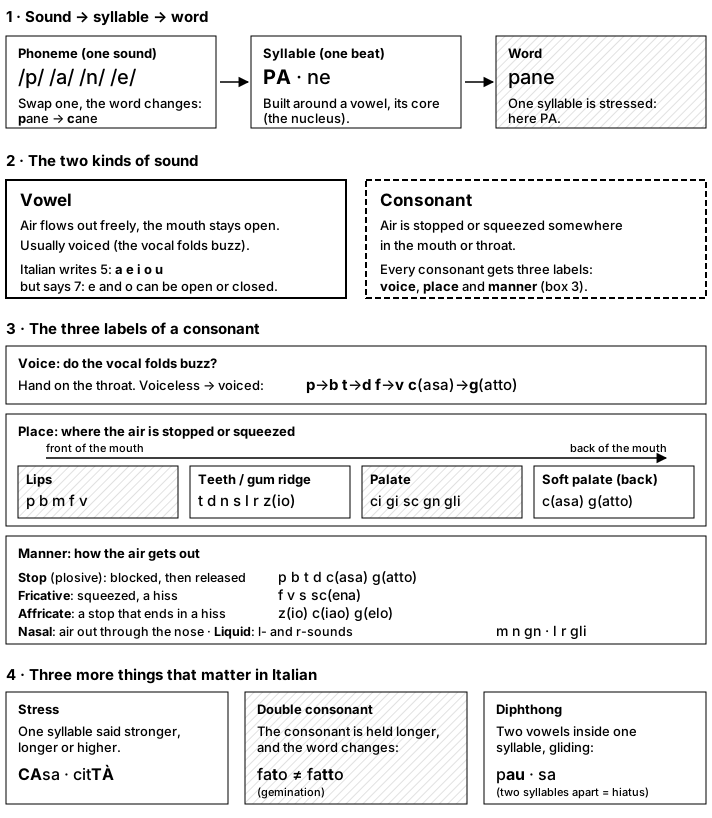
- A phoneme is the smallest sound that tells one word from another, written between slashes 41.
- A vowel is said with the mouth open and little or no blocking; a consonant closes the way fully or in part 42 43.
- A syllable is built around a nucleus, most often a vowel 44. Stress is the extra weight on one syllable: louder, longer, or a change of pitch 45.
- A consonant is described by voice (do the vocal folds vibrate) 46, place (where the narrowing is) 47 and manner (how the air passes) 48.
- The manners: stop blocks the air completely 49; fricative forces it through a narrow gap 50; affricate starts as a stop and ends as a fricative 51; nasal lets the air out through the nose 52; liquid covers the l- and r-sounds 53.
- A double consonant (gemination) is a consonant held longer 54; in Italian fato and fatto are two words 55. A diphthong is two vowel sounds in one syllable; split across two syllables they are a hiatus 56. Italian ai and au are common 57.
- The places of the Italian consonants follow the table of Italian phonology: lips, teeth and gum ridge, palate, soft palate 58.
The phonetic alphabet (IPA) for Italian
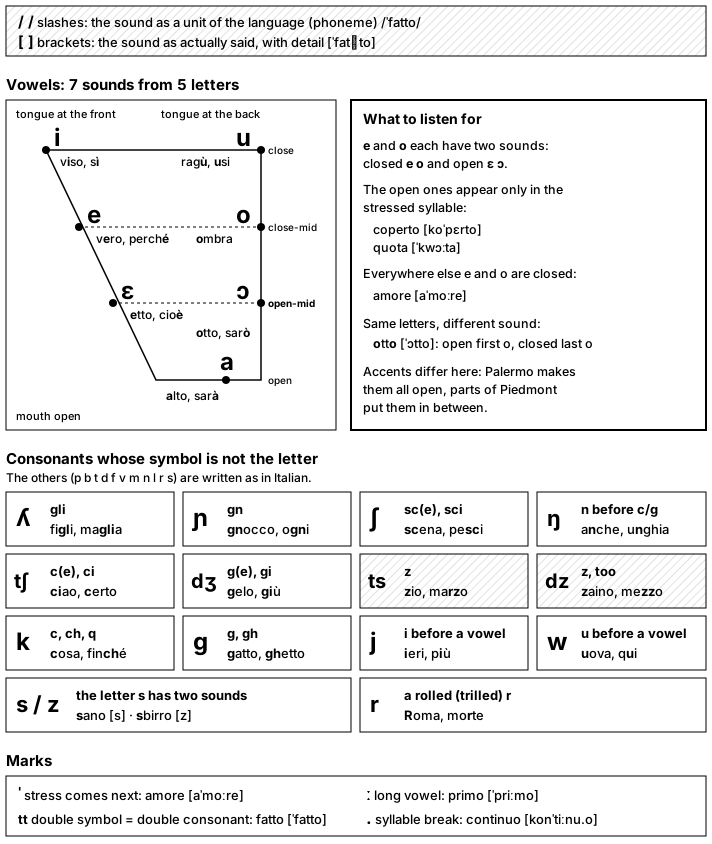
- The IPA (International Phonetic Alphabet) is one standard set of symbols for the sounds of speech, used in every language 59.
- There is no separate alphabet for Italian. Italian uses a part of the same IPA; Wikipedia's Italian key lists the symbols, the example words and the marks shown above 60.
- One Italian linguist, Luciano Canepari, built an extended version called canIPA, for finer detail; it has seen little use outside his own work 61.
- Italian has seven vowels in stressed syllables; the open ɛ ɔ appear only there, the closed e o elsewhere 62. Palermo pronounces them all open and parts of Piedmont in between, so this is where accents show 63.
- The letters s and z each hide two sounds: s is [s] or [z], z is [ts] or [dz] 64.
Licence and how to cite
Text and infographics: CC BY 4.0, Institute of Thinking, 2026. You may copy, share and adapt them with credit. Cite as: Institute of Thinking, Listening words: how to describe a voice, version 1, 28 October 2026, instituteofthinking.com. Wording taken from a source in the notes keeps that source's own licence.
Sources
-
Wikipedia contributors (2026). Prosody (linguistics). https://en.wikipedia.org/wiki/Prosody_(linguistics). p. 1, lead section, revision 1377877018.
-
Wikipedia contributors (2026). High rising terminal. https://en.wikipedia.org/wiki/High_rising_terminal. p. 1, lead section, revision 1372093522.
-
Wikipedia contributors (2026). Loudness. https://en.wikipedia.org/wiki/Loudness. p. 1, lead section, revision 1381124040.
-
Wikipedia contributors (2026). Phonation. https://en.wikipedia.org/wiki/Phonation. p. 1, lead section, revision 1378319920.
-
Wikipedia contributors (2026). Modal voice. https://en.wikipedia.org/wiki/Modal_voice. p. 1, lead section, revision 1364125584.
-
Wikipedia contributors (2026). Whispering. https://en.wikipedia.org/wiki/Whispering. p. 1, lead section, revision 1359390609.
-
Wikipedia contributors (2026). Harsh voice. https://en.wikipedia.org/wiki/Harsh_voice. p. 1, lead section, revision 1332671154.
-
Wikipedia contributors (2026). Falsetto. https://en.wikipedia.org/wiki/Falsetto. p. 1, lead section, revision 1377132866.
-
Wikipedia contributors (2026). Formant. https://en.wikipedia.org/wiki/Formant. p. 1, lead section, revision 1340709526.
-
Wiktionary contributors (2026). casa. https://en.wiktionary.org/wiki/casa#Italian. p. 1, Italian, Pronunciation, revision 93683508.
-
Wikipedia contributors (2026). Speech disfluency. https://en.wikipedia.org/wiki/Speech_disfluency. p. 1, lead section, revision 1369279759.
-
Wikipedia contributors (2026). Filler (linguistics). https://en.wikipedia.org/wiki/Filler_(linguistics). p. 1, lead section, revision 1382079903.
-
Wikipedia contributors (2026). Speech tempo. https://en.wikipedia.org/wiki/Speech_tempo. p. 1, paragraph on pauses and hesitations, revision 1322959091.
-
Wikipedia contributors (2026). Turn-taking. https://en.wikipedia.org/wiki/Turn-taking. p. 1, lead section, revision 1368892558.
-
Alexandre Défossez, Laurent Mazaré, Manu Orsini et al. (2024). Moshi: a speech-text foundation model for real-time dialogue. https://arxiv.org/abs/2410.00037. §5.6.p1 "Metrics", p. 31.
-
Wikipedia contributors (2026). Manner of articulation. https://en.wikipedia.org/wiki/Manner_of_articulation. p. 1, lead section, revision 1363377714.
-
Wikipedia contributors (2026). Intelligibility (communication). https://en.wikipedia.org/wiki/Intelligibility_(communication). p. 1, lead section, revision 1374851940.
-
Wikipedia contributors (2026). Coarticulation. https://en.wikipedia.org/wiki/Coarticulation. p. 1, lead section, revision 1341975227.
-
Wikipedia contributors (2026). Elision. https://en.wikipedia.org/wiki/Elision. p. 1, lead section, revision 1367520909.
-
Wikipedia contributors (2026). Code-switching. https://en.wikipedia.org/wiki/Code-switching. p. 1, lead section, revision 1380977755.
-
Wikipedia contributors (2026). Paralanguage. https://en.wikipedia.org/wiki/Paralanguage. p. 1, lead section, revision 1379872409.
-
Wikipedia contributors (2026). Laughter. https://en.wikipedia.org/wiki/Laughter. p. 1, lead section, revision 1377416505.
-
Wikipedia contributors (2026). Compression artifact. https://en.wikipedia.org/wiki/Compression_artifact. p. 1, lead section, revision 1382098074.
-
Wikipedia contributors (2026). Duplex (telecommunications). https://en.wikipedia.org/wiki/Duplex_(telecommunications). p. 1, lead section, revision 1379236825.
-
Défossez et al., §1 "Introduction", pp. 2–3.
-
Rajarshi Roy, Jonathan Raiman, Sang-gil Lee et al. (2026). PersonaPlex: Voice and Role Control for Full Duplex Conversational Speech Models. https://arxiv.org/abs/2602.06053. §2 "Related Work", pp. 1–2.
-
Guan-Ting Lin, Jiachen Lian, Tingle Li et al. (2025). Full-Duplex-Bench: A Benchmark to Evaluate Full-Duplex Spoken Dialogue Models on Turn-taking Capabilities. https://arxiv.org/abs/2503.04721. pp. 3–5, section III.B, Evaluation Dimensions.
-
Lin et al., §III "Full-Duplex-Bench Framework", p. 3.
-
Lin et al., pp. 3–5, section III.B, Evaluation Dimensions.
-
Lin et al., pp. 3–5, section III.B, Evaluation Dimensions.
-
Lin et al., pp. 3–5, section III.B, Evaluation Dimensions.
-
Wikipedia contributors (2026). Voice activity detection. https://en.wikipedia.org/wiki/Voice_activity_detection. p. 1, lead section, revision 1310320123.
-
Roy et al., §3.1 "Architecture", p. 2.
-
Roy et al., §3.1 "Architecture", p. 2.
-
Défossez et al., §3.4.4.p3 "Joint sequence modeling for Moshi", p. 17.
-
Wikipedia contributors (2026). Audio codec. https://en.wikipedia.org/wiki/Audio_codec. p. 1, lead section, revision 1354433960.
-
Wikipedia contributors (2026). Mean opinion score. https://en.wikipedia.org/wiki/Mean_opinion_score. p. 1, lead section, revision 1380628996.
-
Wikipedia contributors (2026). Word error rate. https://en.wikipedia.org/wiki/Word_error_rate. p. 1, lead section, revision 1281062858.
-
Wikipedia contributors (2026). Speaker recognition. https://en.wikipedia.org/wiki/Speaker_recognition. p. 1, lead section, revision 1380225450.
-
Wikipedia contributors (2026). Emotion recognition. https://en.wikipedia.org/wiki/Emotion_recognition. p. 1, lead section, revision 1380996887.
-
Wikipedia contributors (2026). Phoneme. https://en.wikipedia.org/wiki/Phoneme. p. 1, lead section, revision 1381374426.
-
Wikipedia contributors (2026). Vowel. https://en.wikipedia.org/wiki/Vowel. p. 1, lead section, revision 1380115729.
-
Wikipedia contributors (2026). Consonant. https://en.wikipedia.org/wiki/Consonant. p. 1, lead section, revision 1374049932.
-
Wikipedia contributors (2026). Syllable. https://en.wikipedia.org/wiki/Syllable. p. 1, lead section, revision 1380139128.
-
Wikipedia contributors (2026). Stress (linguistics). https://en.wikipedia.org/wiki/Stress_(linguistics). p. 1, lead section, revision 1381708585.
-
Wikipedia contributors (2026). Voice (phonetics). https://en.wikipedia.org/wiki/Voice_(phonetics). p. 1, lead section, revision 1373877429.
-
Wikipedia contributors (2026). Place of articulation. https://en.wikipedia.org/wiki/Place_of_articulation. p. 1, lead section, revision 1374908094.
-
Wikipedia, “Manner of articulation”, p. 1, lead section, revision 1363377714.
-
Wikipedia contributors (2026). Plosive. https://en.wikipedia.org/wiki/Plosive. p. 1, lead section, revision 1363377527.
-
Wikipedia contributors (2026). Fricative. https://en.wikipedia.org/wiki/Fricative. p. 1, lead section, revision 1382053993.
-
Wikipedia contributors (2026). Affricate. https://en.wikipedia.org/wiki/Affricate. p. 1, lead section, revision 1377342124.
-
Wikipedia contributors (2026). Nasal consonant. https://en.wikipedia.org/wiki/Nasal_consonant. p. 1, lead section, revision 1381336950.
-
Wikipedia contributors (2026). Liquid consonant. https://en.wikipedia.org/wiki/Liquid_consonant. p. 1, lead section, revision 1365850882.
-
Wikipedia contributors (2026). Gemination. https://en.wikipedia.org/wiki/Gemination. p. 1, lead section, revision 1376129427.
-
Wikipedia contributors (2026). Italian phonology. https://en.wikipedia.org/wiki/Italian_phonology. p. 1, section Consonants, revision 1374139897.
-
Wikipedia contributors (2026). Diphthong. https://en.wikipedia.org/wiki/Diphthong. p. 1, lead section, revision 1381622438.
-
Wikipedia, “Italian phonology”, p. 1, section Vowels, revision 1374139897.
-
Wikipedia, “Italian phonology”, p. 1, section Consonants, table of consonant phonemes, revision 1374139897.
-
Wikipedia contributors (2026). International Phonetic Alphabet. https://en.wikipedia.org/wiki/International_Phonetic_Alphabet. p. 1, lead section, revision 1382236090.
-
Wikipedia contributors (2026). Help:IPA/Italian. https://en.wikipedia.org/wiki/Help:IPA/Italian. p. 1, consonant, vowel and suprasegmental tables, revision 1368258444.
-
Wikipedia contributors (2026). Luciano Canepari. https://en.wikipedia.org/wiki/Luciano_Canepari. p. 1, lead section, revision 1342384212.
-
Wikipedia, “Help:IPA/Italian”, p. 1, note to the vowel table, revision 1368258444.
-
Wikipedia, “Italian phonology”, p. 1, section Vowels, revision 1374139897.
-
Wikipedia, “Help:IPA/Italian”, p. 1, consonant table and its notes, revision 1368258444.