 Institute of Thinking
№ 004 — 28 OCT 2026
Listening words: an open dictionary for describing a voice
Building Devotion means listening to a lot of speech: real recordings, and what our own model says back. When one of us hears something wrong, the other needs to know exactly what. “It sounds off” is not enough. “The melody is flat at the end of the line” is.
So we wrote ourselves a dictionary. One plain meaning per word, and an example of how to say it when you hear it.
What is in it
More than a hundred words, in plain English, grouped the way you listen:
- Prosody: pitch, intonation, stress, rhythm, loudness.
- Voice quality: creaky, breathy, whisper, falsetto, the colour of a voice.
- Conversation: turns, gaps, overlaps, interruptions, backchannels.
- Accent and pronunciation, recording noises, and the faults AI voices make.
- The words researchers use to test models that listen while they speak.
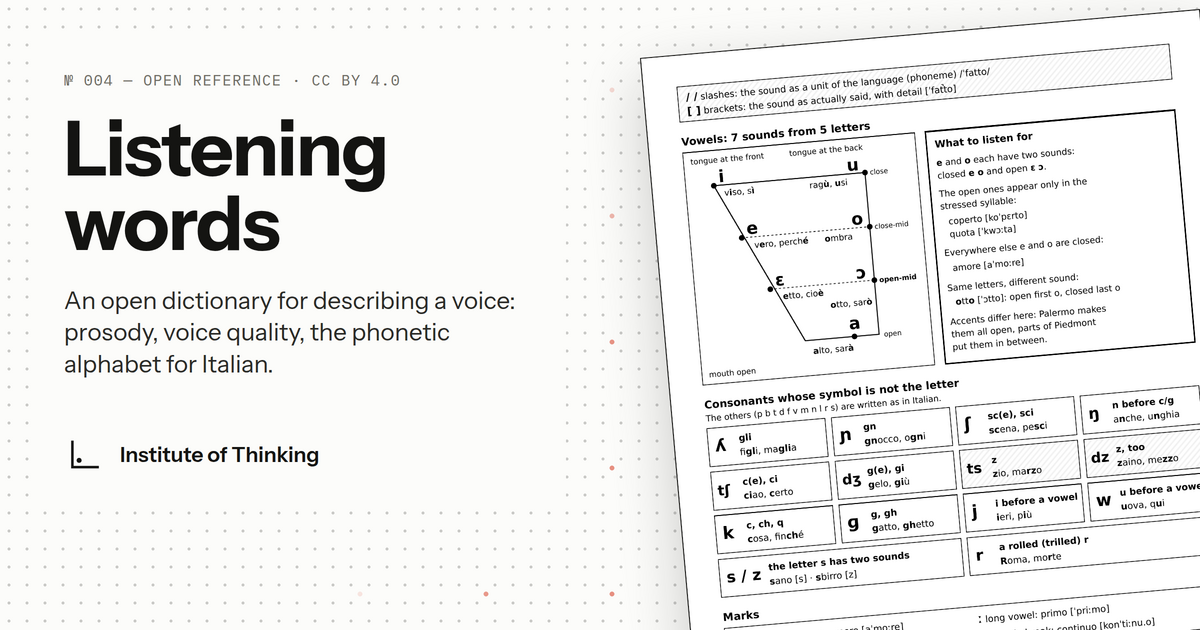
Two one-page infographics close it: the building blocks of speech sounds, and the phonetic alphabet as it is used for Italian.
Where a definition comes from a source, a note says which one and where: a Wikipedia page pinned to the exact revision we read, or the Moshi, PersonaPlex and Full-Duplex-Bench papers. The rest is our own working wording, and the dictionary says so.
A look inside
A few of the entries, as they appear in the dictionary:
- Prosody
- The group name for intonation, stress, rhythm and loudness: the music on top of the sounds.
- Intonation
- The melody of a sentence: where it rises and falls.
- Creaky voice (vocal fry)
- Low rattle, like a slow door, often at line ends.
- Overlap
- Both speak at the same time.
- Backchannel
- Small listening sounds: mhm, sì, ah.
- Barge-in
- The user cuts in and the system should stop and listen.
- Full-duplex
- Both sides can talk at once, like a phone call.
- Vowel colour
- Whether a vowel is open or closed (è vs é).
- Double consonants
- Held consonants in Italian (fatto, not fato).
- Metallic / robotic
- Buzzy, ringing, like a voice through a metal pipe.
- Pumping
- Background noise rises and drops as the voice starts and stops.
The phonetic alphabet page shows the seven Italian vowels (i, e, ɛ, a, ɔ, o, u) on the vowel chart, and the consonants whose symbol is not the letter: ʎ for gli, ɲ for gn, ʃ for sc, tʃ and dʒ for ci and gi, ts and dz for the two sounds of z.
Why share it
We needed it, so others probably do too: anyone who records voices, rates speech models, or just wants the right word for what they hear. It is free to copy, share and adapt under CC BY 4.0.